Danke für den MVP Award für 2016!
Zu meiner Überraschung habe ich am 1.1.2016 folgende Email erhalten:
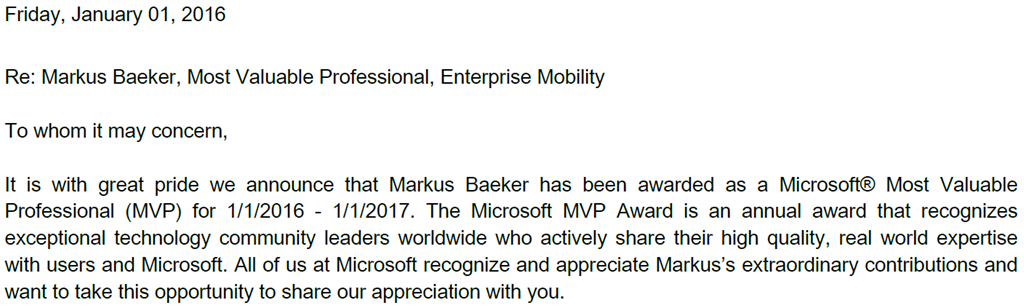
Ich nehme dies als Ansporn mehr Energie in meine Community Kanäle zu legen!
Step by Step instructions for the Nagios connector
Often I receive questions about how to install the connector. Here is a short step by step installation instruction:
- Download the latest release (/downloads/SCOM2Nagios_1.5.zip)
- Extract the archive
- Copy the “Release” folder to c:\
- rename it to scom2nagios
- Copy the “processing.xml” from documentation to c:\scom2nagios
- Start an administrative command shell
- change to c:\scom2nagios (cd /d c:\scom2nagios)
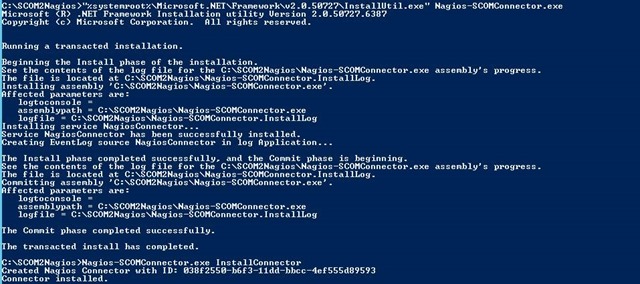
- start the Service Installer with “%systemroot%\Microsoft.NET\Framework\v2.0.50727\InstallUtil.exe” Nagios-SCOMConnector.exe (see the 1. screenshoot)
- Register the connector to SCOM with Nagios-SCOMConnector.exe InstallConnector
- Edit Nagios-SCOMConnector.exe.config and change the ncsaPath (2. screenshoot)
![clip_image002[4]](/wp-content/uploads/2013/04/clip_image0024_thumb.jpg "clip_image002[4]")
- Edit the service “KIT Nagios Connector” to Restart on Failure (3. Screenshoot)
![clip_image002[6]](/wp-content/uploads/2013/04/clip_image0026_thumb.jpg "clip_image002[6]")
- Select the connector in the OpsMgr Console (Administration –> Product Connectos –> Internal Connector, 4. Screenshoot)
![clip_image002[8]](/wp-content/uploads/2013/04/clip_image0028_thumb.jpg "clip_image002[8]")
- Right click the conenctor and select Properties (Screenshot 5)
![clip_image002[10]](/wp-content/uploads/2013/04/clip_image00210_thumb.jpg "clip_image002[10]")
- Add a suitable subscription to the connector to send alerts to it.
![clip_image002[12]](/wp-content/uploads/2013/04/clip_image00212_thumb.jpg "clip_image002[12]")
![clip_image002[4]](/wp-content/uploads/2013/04/clip_image0024.jpg "clip_image002[4]")
![clip_image002[6]](/wp-content/uploads/2013/04/clip_image0026.jpg "clip_image002[6]")
![clip_image002[8]](/wp-content/uploads/2013/04/clip_image0028.jpg "clip_image002[8]")
![clip_image002[10]](/wp-content/uploads/2013/04/clip_image00210.jpg "clip_image002[10]")
![clip_image002[12]](/wp-content/uploads/2013/04/clip_image00212.jpg "clip_image002[12]")
SCSM: Mass deleting incidents
Sometimes if you are testing the import of a bunch of incidents, it is necessary to delete them.
As usual you can do it with a one-line powershell:
This command deletes all incidents that are created from yesterday to now:
(Get-SCSMClass -Name "System.WorkItem.Incident" | Get-SCSMClassInstance)
 | where {$_.FirstAssignedDate -gt ((get-Date).addDays(-1))} | Remove-SCSMClassInstance
In SCSM you first have to retrieve the class you are interessted in. After that you search for all instances of this class. The last command Remove-SCSMInstance deletes all matching instances.
SCOM: Notify by ICQ, MSN, Jabber or Facebook
 On thing I was always missing in System Center Operations Manager (SCOM) was the notification with other instant messaging (IM) protocols than the build in Microsoft Communicator.
On friday I had some time to test a solution which I will describe here.
On warnung at the beginning: This current solution is experimental. It will run a Miranda client in the system context and can be a large security hole for your SCOM server!
The first thing I had to to is finding a client which can be controlled by command line or by a SDK. I stumbled upon the command line plugin for Miranda IM. Miranda IM is an open source mutli-protocol instant messaging client. With it you can integrate multiple protocols with plugins.
SCOM2Nagios 1.5
Find the newest version on top of: </tag/scom2nagios/>
Released a new Version of the SCOM2Nagios Connector. Changes:
1.5
- NEW: NagiosHost2 and NagiosPort2 in config (fast change upon request)
- BUG: Processings equals instruction hasnt’t worked correctly
This is currently a fast release without much testing. Please add a comment if anything is broken!
Monitoring Fedora Core 4 with SCOM 2007 R2 – Part 3
 In the part 3 of the Fedora Core 4 discovery pack I will explain the creation of the discovery management pack in detail.
Creating the new MP for Discovery:
- Open the Authoring Console (please use the newest on. I have used 6.1.7221.49)
- File –> New and enter the required values
- File –> Management Pack Properties
- Select the tab References –> Add Reference
- Add Reference to Microsoft.Linux.RHEL.4, change the alias to RHEL4 (it’s shorter and easier to use) and a reference to the Microsoft.Unix.Library with the alias Unix. Your reference tab should look like the picture 1 (the picture has another reference to linux but this will be added automaticly with the discovery)
- Switch to Health Model, select Discovery
- new Custom Discovery, name Technidata.Fedora.4.Computer.Discovery
- Target: Microsoft.Linux.RedHat.Computer
- Discovered Classes: Add class Microsoft.Linux.RHEL.4.Computer
- Configuration: Browse… and select: Microsoft.Unix.WSMan.TimedEnumerate.Filtered.MatchesRegularExpression.DiscoveryData and add a module id like discovery
- Press Edit and enter the xml from part 2 into the editor: replace the text between Configuration> and with the XML text
[…] - Close the editor
- your discovery tab should look like picture 2
- Do the same with the second xml from part 2
- Your discovery pack is ready to be imported into your test SCOM environment.
Fileservermigration mit DFSR
 DFS ermöglicht nicht nur eine einheitliche Sicht bzw. Einstiegspunkt auf die Dateien im Unternehmen, sondern ermöglicht auch ein transparentes Umziehen der Dateien von einem Server auf einen anderen.
Dabei wird zuerst eine Replikation zwischen alten und neuem Fileserver mittels DFSR eingerichtet. DFSR ist trotz des Namens unabhängig von DFS, d.h. hierfür müssen die Fileserver nicht als Ziel eines DFS Zweiges eingerichtet sein.
Monitoring Fedora Core 4 with SCOM 2007 R2 – Part 2
 The creation of the troja management pack is easy. You only have to add to discovery tasks which create the RHEL4 computer object and the operating system object and fills them with some basic informations.
In the authoring console you have the add a reference to the Microsoft.Linux.RHEL.4 MP because we will use the RHEL4 Computer object.
This is the XML code of the first discovery task:
Discovery $Target/Property[Type=”Unix!Microsoft.Unix.Computer”]/NetworkName$ [http://schemas.microsoft.com/wbem/wscim/1/cim-schema/2/SCX\_OperatingSystem?\__cimnamespace=root/scx][1] false 300 //*[local-name()=”Caption”] .\*Fedora Core release 4.\* $MPElement[Name=”RHEL4!Microsoft.Linux.RHEL.4.Computer”]$ $MPElement[Name=”Unix!Microsoft.Unix.Computer”]/PrincipalName$ $Target/Property[Type=”Unix!Microsoft.Unix.Computer”]/PrincipalName$ $MPElement[Name=”Unix!Microsoft.Unix.Computer”]/TimeZoneOffset$ $Data///*[local-name()=”CurrentTimeZone”]$
Monitoring Fedora Core 4 with SCOM 2007 R2 – Part 1
 Fedora bases upon Red Hat Enterprise linux which is supported by SCOM. Fedora Core 3 was the base of RHEL 4 and Fedora Core 6 RHEL 5. In this blog posts I will try to convince SCOM that the Fedora 4 based Asterisk telecom system is a RHEL 4.
First we have to install the RHEL4 scom agent manual onto the systems. In this case we had to install the OpenSSL library, too. Additional we add the scom user account to the system.
After that we sign the local created certificate by the scom server and replace it on the Fedora system.
Now we can test the connection from the SCOM server with this winrm command:
winrm enumerate http://schemas.microsoft.com/wbem/wscim/1/cim-schema/2/SCX_OperatingSystem?__cimnamespace=root/scx -username:scomuser -password:yourpassword -r:https://your.fedora.system:1270/wsman -auth:basic -encoding:UTF-8
The output shows detail information about the OS:
Support policy for Microsoft SQL Server products that are running in a hardware virtualization environment
 If you want to know if it is supported to run the SQL Server in a virtualized environment than this is the right article for you:
http://support.microsoft.com/kb/956893/en-us
Summaries:
- SQL 2005 or higher is supported on Hyper-V or a hypervisor validated in the SVVP program
- Snapshots of the VM are NOT supported.
- Hyper-V Dynamic Memory is supported but only useful with SQL Server version Enterprise and Datacenter